Among all Incoterms used in international trade, even experienced traders sometimes confuse the two—FCA (Free Carrier) and FOB (Free On Board) especially when dealing with container shipments.
In practice, FOB is still more commonly used alongside EXW and CIF, whereas FCA is mentioned less frequently in day-to-day trading. Because of this, many traders continue to misunderstand the differences between FCA and FOB. However, understanding the distinction is essential, as it determines when risk transfers from the seller to the buyer (It is always about risk management!).
What Is FOB in Incoterms?
FOB (Free On Board) is an Incoterm designed specifically for sea freight and inland waterway transport.
Under FOB, the seller’s responsibility continues until the goods are loaded on board the vessel at the port of shipment.
In simple terms:
- The seller delivers the goods to the port and loads them onto the vessel.
- Risk transfers when the goods are on board the ship.
- The buyer takes responsibility for ocean freight and all subsequent transportation.
For example, if you are importing under FOB Shanghai terms and need the shipment delivered to Singapore, you would be responsible for booking and arranging ocean freight from Shanghai Port to Singapore Port. The exporter is responsible for delivering the goods to Shanghai Port and loading them onto the vessel. Once the cargo is on board, the responsibility transfers to the importer.
What Is FCA in Incoterms?
FCA (Free Carrier) is a multimodal Incoterm, meaning it can be used for any type of transportation, including truck, rail, air, or sea.
Under FCA, the seller fulfills their obligation when the goods are delivered to the carrier nominated by the buyer at the agreed location.
This means:
- The seller handles export clearance (this is the same under both FOB and FCA).
- The seller delivers the goods to the buyer’s nominated carrier.
- Risk transfers when the goods are handed over to the carrier.
The delivery location under FCA can vary, such as:
- Seller’s factory or warehouse (FCA Seller’s Premises) – this is not the same as EXW, particularly in terms of responsibility for export clearance and loading onto the carrier.
- Container terminal
- Inland logistics hub
FCA vs FOB: The Key Difference
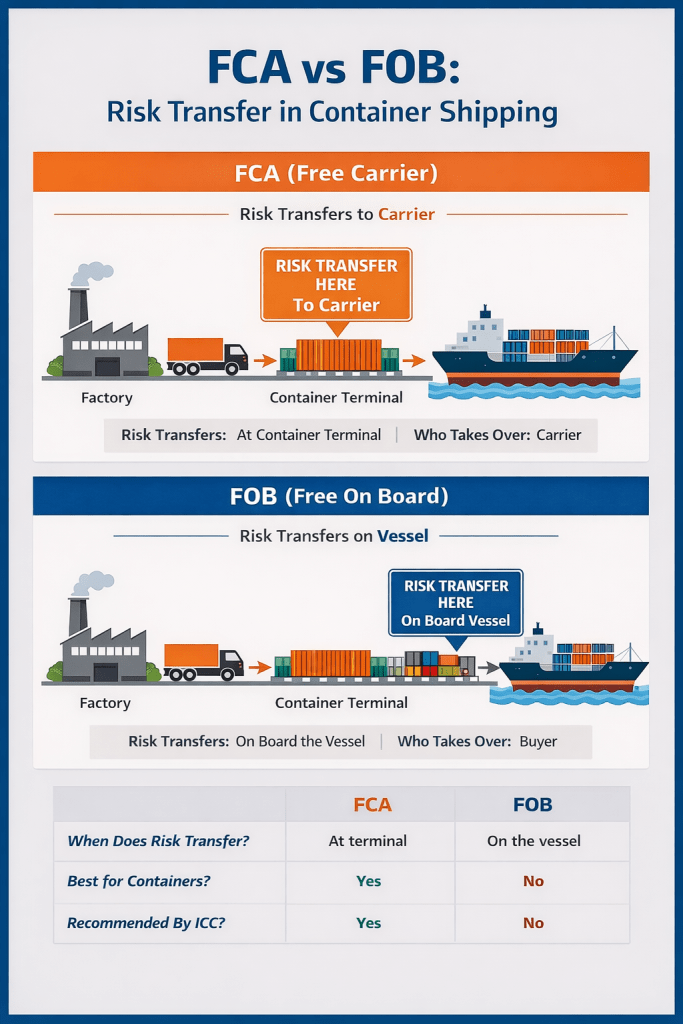
The main difference between FCA and FOB is the point at which risk transfers from the seller to the buyer.
- FCA: Risk transfers when the goods are delivered to the carrier.
- FOB: Risk transfers when the goods are loaded onto the vessel.
The diagram illustrates where risk transfers under FCA and FOB in container shipping.
Why FOB Is Often Misused in Container Shipping
In today’s containerized shipping environment, cargo typically moves through a process like this:
Factory → Container Terminal → Vessel
The exporter usually delivers the container to a terminal (Container Yard or CY), after which the terminal operator handles the vessel loading.
However, under FOB, the seller technically carries the risk until the goods are loaded onto the vessel, even though the seller no longer controls the cargo once it enters the terminal.
For this reason, the International Chamber of Commerce (ICC) recommends using FCA instead of FOB for container shipments.
When Should You Use FCA Instead of FOB?
As a practical guideline:
Use FOB when:
- Cargo is bulk or non-containerized
- The seller directly loads the goods onto the vessel
Use FCA when:
- Cargo is containerized
- Goods are delivered to a terminal or logistics hub
- The seller hands the goods over to a carrier rather than loading the vessel
Conclusion
The difference between FCA and FOB ultimately comes down to one critical question: when does the risk transfer?
- Under FOB, risk transfers when the goods are loaded onto the vessel.
- Under FCA, risk transfers when the goods are delivered to the carrier.
In practice, FOB is still commonly used alongside terms such as EXW and CIF, while FCA is mentioned less frequently in everyday trading. However in modern container logistics, FCA often reflects the actual operational process more accurately than FOB. Understanding this distinction helps traders structure contracts more clearly and avoid unnecessary disputes in international shipments.
 Real insights from the world of global trade