You may frequently hear terms like “EBS cost” or “EBS surcharge” but many shippers still do not fully understand how significantly EBS can impact total logistics costs.
As global fuel prices fluctuate and geopolitical risks continue affecting supply chains recently, EBS has become an increasingly important factor in ocean freight pricing.
For importers, exporters, and freight forwarders, understanding how each carrier applies EBS can help improve freight budgeting, contract negotiations, and shipment planning.
What is EBS?
→ EBS stands for Emergency Bunker Surcharge.
It is an additional surcharge imposed by ocean carriers to offset sudden increases in fuel costs or unexpected operational expenses related to bunker fuel.
Unlike regular fuel adjustment mechanisms such as BAF (Bunker Adjustment Factor), EBS is typically introduced during periods of market instability or rapid cost increases.
In practice, carriers may apply EBS when:
- Oil prices rise rapidly
- Geopolitical disruptions affect fuel supply
- Operational costs spike unexpectedly
- Market volatility impacts carrier profitability
EBS can change frequently and may vary by:
- Shipping line
- Origin and destination
- Container type
- Season
- Trade route
Why Does EBS Differ by Shipping Line?
Each ocean carrier operates under a different business structure and cost strategy.
Factors that influence EBS policies include:
- fuel procurement methods,
- fleet efficiency,
- network coverage,
- operational costs,
- and pricing strategy.
As a result, EBS levels are rarely identical across carriers.
Some shipping lines maintain relatively stable surcharge structures, while others adjust EBS more aggressively according to market conditions and fuel volatility.
From a shipper’s perspective, this makes carrier comparison increasingly important when calculating total landed costs.
EBS Policies by Major Shipping Lines
Maersk
The company typically incorporates fuel-related adjustments through mechanisms such as:
- BAF (Bunker Adjustment Factor),
- and EFF (Emergency Fuel Fee) in selected markets.
Large-volume shippers often appreciate Maersk’s transparency regarding fuel cost calculations.
MSC (Mediterranean Shipping Company)
MSC tends to apply EBS more flexibly depending on:
- market demand (faster surcharge adjustments, responsive to market fluctuations),
- trade imbalance,
- fuel market conditions,
- and seasonal congestion (higher exposure for spot-rate shipments).
In volatile freight markets, spot-rate cargo booked with MSC may experience more frequent EBS revisions compared to long-term contract cargo.
CMA CGM
CMA CGM actively updates fuel-related surcharges through:
- BAF
- Low Sulphur Surcharge (LSS),
- and route-specific EBS adjustments.
The carrier is also heavily focused on:
- IMO environmental compliance,
- alternative fuels,
- and sustainable shipping initiatives.
As environmental regulations continue to evolve, fuel surcharge structures across the industry are becoming increasingly complex.
Hapag-Lloyd
Hapag-Lloyd is widely recognized for providing detailed surcharge notices and formula-based explanations.
Its EBS structure often includes:
- route-specific fuel calculations,
- periodic surcharge updates,
- transparent documentation,
- and detailed customer advisories.
Many freight forwarders appreciate Hapag-Lloyd for its relatively clear communication regarding fuel-related surcharges.
ONE (Ocean Network Express)
ONE frequently applies EBS in Asian export markets for:
- fuel volatility,
- equipment shortages,
- and space constraints
As a result, exporters in Asia closely monitor ONE’s surcharge announcements during busy shipping periods.
Evergreen Marine
Evergreen’s EBS policies are generally considered competitive in Asia-focused trade lanes.
The company typically balances:
- operational cost recovery,
- market competitiveness,
- and long-term customer retention.
Shippers operating in Taiwan, China, and Southeast Asia often compare Evergreen’s EBS levels carefully against other regional carriers.
How EBS Impacts Freight Costs
At first glance, EBS may appear to be a relatively small surcharge per container. However, its overall impact can become substantial when shipping volume increases.
EBS can significantly affect total landed cost when:
- shipping high container volumes,
- moving low-margin products,
- relying on spot freight rates,
- or operating during fuel price spikes.
For example:
| Shipment Type | Potential EBS Impact |
| Single container shipment | Moderate |
| 50 containers per month | Significant |
| Low-margin cargo | High sensitivity |
| Long-haul trade routes | Greater exposure |
From a logistics budgeting perspective, even relatively small EBS adjustments can accumulate quickly over time.
Tips for Managing EBS Effectively
1. Monitor Carrier Announcements
Most shipping lines publish updated surcharge notices through their official websites and customer advisories.
Regular monitoring can help shippers avoid unexpected freight increases and improve shipment planning accuracy.
This becomes especially important during periods of geopolitical instability, such as concerns surrounding the U.S.–Iran conflict or disruptions in the Strait of Hormuz, when fuel-related surcharges may rise rapidly.
2. Negotiate Long-Term Contracts
Long-term freight agreements for more stable adjustment formulas, lower pricing volatility and better budgeting predictability.
For high-volume shippers, contract-based pricing can help reduce sudden EBS exposure.
3. Compare Total Cost, Not Just Ocean Freight
A lower base freight rate can become expensive after:
- EBS
- PSS (Peak Season Surcharge)
- Congestion surcharges
- Equipment imbalance fees
Always evaluate the full cost structure.
4. Diversify Carrier Options
Relying too heavily on a single shipping line can increase exposure to sudden surcharge adjustments.
Many freight forwarders and global shippers maintain multiple carrier relationships to improve flexibility and reduce pricing risk during volatile market conditions.
5. Q&A
1. Can EBS Be Negotiated?
→ In practice, EBS is not always fully negotiable.
For long-term contract customers, some carriers may:
- cap surcharge increases,
- offer fixed BAF structures,
- or partially absorb fuel volatility.
However, during peak seasons or space shortages, many shipping lines apply EBS uniformly across the market regardless of customer size.
For spot-rate cargo, shippers typically have less negotiating power regarding sudden EBS adjustments.
2. Is it always called EBS?
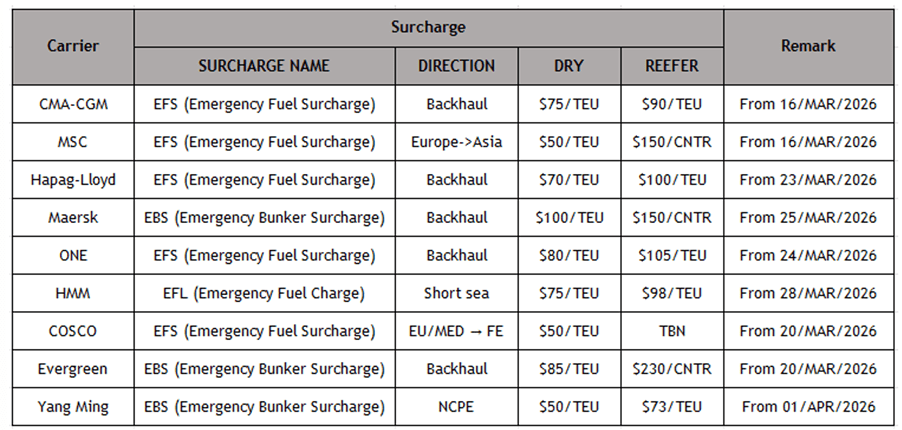
→ One important point for shippers is that not every carrier uses the exact term “EBS.” As you can see from ‘Carrier surcharge rates for March 2026 as an example’ table above, different abbreviations are used by the carriers, such as EFS, EBS and EFL.
As a result, comparing freight quotations across carriers can sometimes be more complicated than expected.
3. How often does EBS rates change?
→ There is no universal answer to this. Therefore, you need to pay close attention to carrier surcharge notices, effective dates and market development, especially if the fuel cost changes significantly. In stable market environments, EBS may remain unchanged for several weeks or even months. However, during periods of:
- fuel price volatility,
- geopolitical instability,
- peak shipping seasons,
- or vessel space shortages,
shipping lines may revise EBS levels multiple times within a single month.
Some shipping lines also implement EBS with relatively short notice periods, meaning shippers may face revised surcharges even for cargo that has already been planned or booked.
For this reason, logistics teams closely monitor:
- cargo cutoff dates,
- vessel ETD changes,
- and surcharge implementation schedules.
Even a few days of delay can sometimes lead to unexpected cost increases.
4. Why Dry & Reefer EBS prices are different?
→ Reefer shipments typically face higher fuel-related surcharges because refrigerated containers consume additional energy during transportation.
As a result, industries such as food, pharmaceuticals, and temperature sensitive chemicals are often more sensitive to EBS fluctuations.

