UN Dangerous Goods Classes 1 – 9
The United Nations (UN) classification is widely used in international shipping. In my 15+ years of chemical trading, UN classifications have been the standard reference for international dangerous goods shipments.
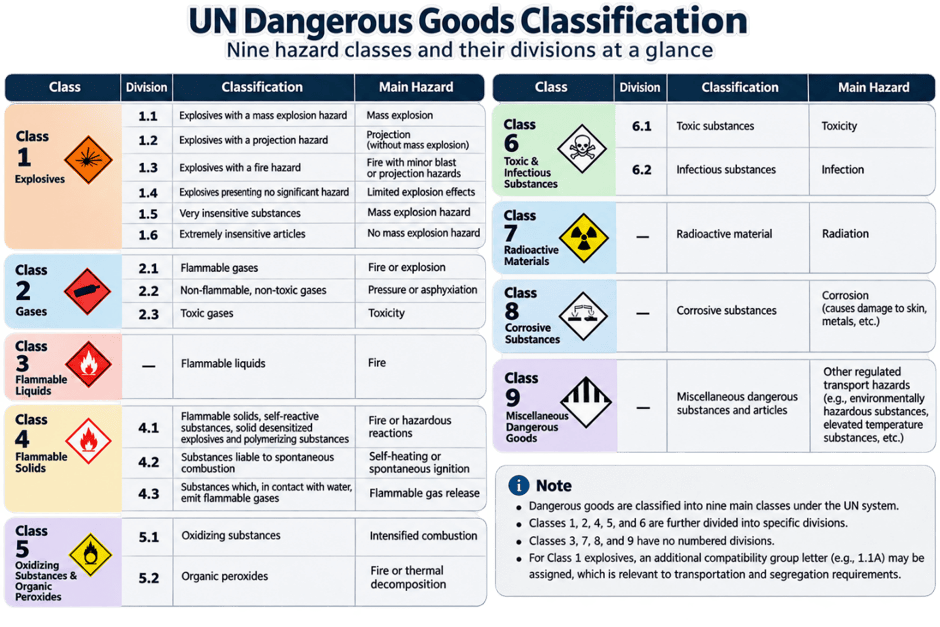
The UN classifies dangerous goods into nine main hazard classes, helping exporters, importers, and logistics providers identify transportation risks and applicable shipping requirements.
What Are UN Numbers?
In addition to hazard classes, dangerous goods are assigned four-digit UN Numbers for identification during transportation.
| UN Number | Product | Class |
| UN 1090 | Acetone | 3 |
| UN 1170 | Ethanol | 3 |
| UN 1789 | Hydrochloric Acid | 8 |
| UN 1824 | Sodium Hydroxide Solution | 8 |
Certain dangerous goods are also assigned Packing Groups:
| Packing Group | Degree of Danger |
| I | High |
| II | Medium |
| III | Low |
Not all dangerous goods have packing groups. For example, Class 1 explosives use hazard divisions and compatibility groups instead.
For the actual reference, please check: UNECE — Transport of Dangerous Goods
So, why does classification matter?
Correct classification affects several aspects of international shipping:
- Shipping Methods: Acceptance and restrictions for air, sea, and land transportation
- Packaging & Labeling: Applicable safety and hazard communication requirements
- Documentation: Dangerous goods declarations and shipping documents
- Logistics Costs: Special handling, carrier restrictions, and related charges
Where Can I Check the Classification?
The first reference is usually Section 14 (Transport Information) of the product’s Safety Data Sheet (SDS), also commonly referred to as MSDS (Material Safety Data Sheet).
This section generally provides the UN Number, Proper Shipping Name, Transport Hazard Class, and Packing Group, where applicable.
The classification should also be verified against the applicable transportation regulations, such as the IMDG Code for sea freight or the IATA Dangerous Goods Regulations for air freight.
What Is the Difference Between UN Numbers, IMDG Code, and IATA DGR?
A UN Number identifies a dangerous substance or article for transportation, while the IMDG Code and IATA DGR specify how dangerous goods must be transported by sea and air, respectively.
| Reference | Purpose | When to Use |
| UN Number | Identifies dangerous goods | When identifying and classifying a product for transportation |
| IMDG Code | Regulates dangerous goods transported by sea, mainly in packaged form | When arranging ocean freight |
| IATA DGR | Specifies dangerous goods requirements for air transportation, based on ICAO Technical Instructions | When arranging air freight or international air courier shipments |
For example, Acetone is classified as UN 1090, Class 3, Packing Group II.
The UN Number identifies the product, but the applicable shipping requirements must be checked against the IMDG Code for ocean freight or the IATA DGR for air freight.
In short, the UN Number tells us what we are shipping, while the IMDG Code and IATA DGR tell us how we can ship it.
Note: One thing to note is that the IMDG Code mainly applies to dangerous goods transported in packaged form. Chemicals transported in bulk by chemical tankers may be subject to separate regulations, such as the IBC Code.
Does it apply to domestic transportation and storage?
I can only give a country-specific perspective on this, using Korea as an example.
UN numbers are useful for determining international shipping requirements, such as whether a product can be shipped by ocean freight or air freight, and what type of carrier or vessel can accept the cargo.
However, when importing, storing, or handling chemicals in Korea, they are also subject to local regulations, such as the Chemicals Control Act (화관법).
There is also a separate classification system under the Dangerous Substances Safety Control Act (위험물안전관리법), overseen by the National Fire Agency. For example, flammable liquids are classified into different petroleum categories (Class I, II, III, etc.), with further distinctions between water-soluble and water-insoluble substances.
Therefore, the simple answer is no. Meeting international shipping requirements does not necessarily mean the product meets local regulatory requirements. In Korea, domestic regulations also apply.
Which Regulations Apply and When (Korea Case)?
| Situation | Applicable Regulation | What to Check |
| International Shipping – Sea | IMDG Code | UN Number, DG Class, Packing Group (if applicable), vessel/carrier acceptance |
| International Shipping – Air | ICAO TI / IATA DGR | UN Number, DG Class, air transport restrictions, packaging requirements |
| Before Importing into Korea | Chemicals Control Act, K-Reach Act | Chemical identification, required declarations, permits or approvals |
| Customs Clearance | Customs Act & Import Regulations | HS Code, customs documents, applicable import approvals |
| Domestic Transportation Chemical, Storage & Handling | Chemicals Control Act | Hazardous chemical designation, handling and facility requirements |
| Fire Safety & Storage | Dangerous Substances Safety Control Act | Petroleum category, water solubility, designated quantity and storage requirements |
How Are the Classification Systems Different?
| Classification System | Main Purpose | Example |
| UN Dangerous Goods Classification | Identifies transportation hazards | UN 1090 – Acetone, Class 3, PG II |
| Chemicals Control Act | Regulates designated chemicals and related import, handling and management obligations | Hazardous chemical designation |
| Dangerous Substances Safety Control Act | Regulates fire-related hazardous materials, storage and handling | Class 4 Flammable Liquids, Class I Petroleum, water-soluble / water-insoluble |
Note: One important distinction is that UN Class 4 and Korean Hazardous Materials Class 4 are not the same.
| Classification | Meaning |
| UN Class 4 | Flammable Solids and Related Substances |
| Korean Hazardous Materials Class 4 | Flammable Liquids |
Even though both use the number 4, they refer to different hazards under different regulatory systems.

