When people first learn about Free Trade Agreements (FTAs), the concept sounds fairly simple: if two countries have an FTA and your product qualifies as originating, the importer can benefit from a reduced or zero tariff.
But how does this work in practice?
One thing I have learned through actual import and export transactions is that the rules for proving origin can be surprisingly different from country to country and from one trade agreement to another.
A document that works perfectly for one country may not be sufficient for another. Some agreements require a Certificate of Origin issued by an authorized organization, while others allow exporters to certify origin themselves. Some customs authorities accept electronic documents or copies in normal import procedures, while others may require an original document.
Here are a few examples from my own experience working with imports and exports involving Korea.
China: An Official FTA Certificate of Origin
Under the Korea-China FTA, proof of origin follows an authority-issued certification system.
In other words, an exporter cannot simply write a statement on its commercial invoice and expect the importer to receive the preferential tariff rate. A valid Korea-China FTA Certificate of Origin must be issued by an authorized issuing authority.
From my experience importing Chinese products into Korea, the process has been relatively convenient because a copy of the Certificate of Origin can generally be used for the Korean import procedure. This means that we normally do not have to wait for an original paper certificate to arrive by courier before proceeding with customs clearance.
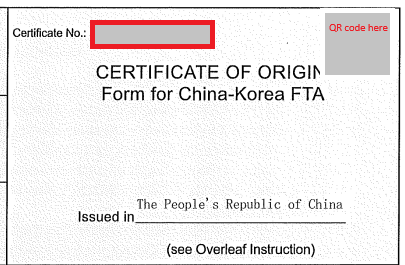
However, this should not be interpreted as meaning that an original can never be requested. Korean Customs may still request supporting or original documentation when verification is necessary.
The important lesson is that the Korea-China FTA is based on an officially issued Certificate of Origin, rather than a simple self-declaration by the exporter.
India: CEPA!
Korea and India have a Comprehensive Economic Partnership Agreement, commonly referred to as the Korea-India CEPA.
To claim preferential tariff treatment under the CEPA, the goods must satisfy the applicable rules of origin and be supported by the prescribed Korea-India CEPA Certificate of Origin. Similar to China’s case, Korea-India CEPA uses an authority-issued Certificate of Origin.
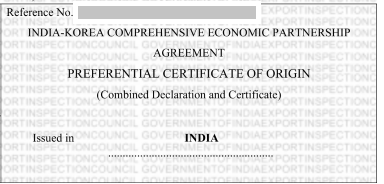
When importing qualifying Indian goods into Korea, Korean import procedures can generally be handled using a copy of the relevant Certificate of Origin, subject to Customs’ right to request additional verification.
When the direction is reversed and Korean goods are imported into India, however, Indian importers often request the original CEPA Certificate of Origin. This is not merely a commercial preference: the Korea-India CEPA’s origin procedures specifically contemplate the original Certificate of Origin being forwarded to the importer for submission to the customs authority at the place of importation.
And Then There Is CAROTAR
For exports to India, another layer of origin compliance comes into play: CAROTAR, India’s Customs Administration of Rules of Origin under Trade Agreements.
This is an important distinction because CAROTAR is not another Certificate of Origin. Rather, it places additional responsibility on the Indian importer to possess sufficient information demonstrating that the imported goods actually satisfy the applicable rules of origin.
A Form I is used by the Indian importer to maintain and organize the origin-related information required under CAROTAR. It is not a Certificate of Origin issued by a government authority.
From an exporter’s perspective, however, CAROTAR can result in additional documentation requests even after the CEPA Certificate of Origin has been properly issued. Therefore, when exporting from Korea to India, issuing the CEPA Certificate of Origin may not be the end of the origin-related paperwork.
The United States: Much More Flexible Certification
The Korea-U.S. FTA, or KORUS FTA, works quite differently.
Unlike the Korea-China FTA or Korea-India CEPA, there is no mandatory government-issued Certificate of Origin form under KORUS.
A certification of origin can be provided by the exporter, producer or importer, and there is no prescribed form. The certification can be written or electronic, provided that it contains the information required under the agreement.
This makes the system considerably more flexible.
For example, origin certification information may be incorporated into commercial documentation rather than requiring a separate government-issued certificate.
There is also a small-value exemption. For imports into Korea under KORUS, goods with a customs value of US$1,000 or less may generally be exempt from the requirement to provide a Certificate of Origin, subject to anti-avoidance conditions.
European Union: The Approved Exporter System
The Korea-EU FTA provides another good example of how different origin systems can be.
Instead of obtaining a government-issued Certificate of Origin for each shipment, exporters generally use an Origin Declaration on an invoice or another qualifying commercial document.
The €6,000 threshold is particularly important.
For consignments containing originating products with a total value of €6,000 or less, an exporter can generally make the required origin declaration even without Approved Exporter status.
For shipments exceeding €6,000, however, the origin declaration must generally be made by an Approved Exporter. The exporter’s customs authorisation number is then included in the prescribed origin declaration.
In actual business, this makes European transactions feel quite different from Chinese or Indian transactions.
Instead of asking, “Where is the official FTA Certificate of Origin?”, the first things I tend to check are:
“Do you have the Approved Exporter authorisation number?“
It is also important to understand that simply placing an Approved Exporter number on an invoice is not enough. The prescribed origin declaration must be properly made, and, more importantly, the exporter must be able to substantiate the originating status of the goods.
!!!The Risk That Appears After Customs Clearance!!!
This leads to one of the most important lessons I have learned from working with the Korea-EU FTA:
Receiving the preferential tariff at the time of import does not necessarily mean that the origin issue is finished.
The Korea-EU FTA has a subsequent verification mechanism.
A proof of origin may be verified after importation, either on a random basis or when the customs authorities have reasonable doubts regarding the authenticity of the origin documentation, the originating status of the products, or compliance with other requirements of the agreement.
| For example, when an EU-origin product has already been imported into Korea using the preferential FTA tariff, Korean Customs may subsequently request the customs authority of the relevant EU exporting country to verify the origin. Under the Korea-EU FTA verification procedure, the requested authority is generally given up to 10 months to provide the results of the verification. |
The EU customs authority may then require the exporter to demonstrate that the goods actually qualified as EU-originating products.
This is where the real risk begins.
An Approved Exporter number is essentially an authorisation to make origin declarations. It is not, by itself, proof that every product shipped by that exporter automatically qualifies for preferential origin.
The exporter must still have sufficient documentation to demonstrate how the applicable rule of origin was satisfied. Depending on the product and the applicable origin criterion, this may involve production records, bills of materials, information on non-originating materials, supplier declarations, HS classifications, manufacturing processes, or other supporting evidence.
Imagine this situation:
A Korean importer has been purchasing a European product for several years.
Every shipment includes a properly worded origin declaration and the exporter’s Approved Exporter number, so the Korean importer claims the preferential Korea-EU FTA tariff each time.
Customs clearance proceeds normally.
Then, sometime later, the origin of the product is selected for verification.
The EU exporter is asked to substantiate the origin of the goods but cannot provide sufficient records demonstrating that the product actually met the applicable rule of origin.
At that point, the fact that the shipments had already cleared customs does not necessarily protect the importer.
If the preferential origin cannot ultimately be verified, the FTA preference may be denied. The Korean importer may then face a demand for the customs duties that had previously been reduced or exempted, together with other amounts that may be payable under the applicable customs rules.
This can create a substantial financial exposure when the same product has been imported repeatedly over an extended period.
A Certificate Is Only the Beginning
This is why I have come to view FTA origin documentation differently.
At first, it is easy to think:
“We have the origin declaration, so we can apply the FTA tariff.”
But the more important question is:
“If Customs asks us to prove this origin several years from now, can the exporter actually do it?”
This distinction is especially important when working with long-term suppliers.
A valid-looking invoice declaration and an Approved Exporter number may allow the importer to claim preferential treatment at the time of customs clearance. However, they do not eliminate the possibility of subsequent origin verification.
For importers, this creates a risk that is easy to overlook.
The immediate benefit of an FTA is visible: lower import duties.
The potential liability is much less visible: those savings may later be challenged if the origin cannot be substantiated.
For that reason, when establishing a long-term supply relationship, I believe origin compliance should be discussed with the supplier from the beginning.
The question should not simply be:
“Can you put your Approved Exporter number on the invoice?”
A better question is:
“If there is a customs verification in the future, do you have the records and origin-management system necessary to prove that this product qualifies under the Korea-EU FTA?”
That small difference in the question can make a very large difference several years later.
Q&A:
1. What if the producer and the exporter are different?
→ The exporter does not necessarily have to be the producer of the goods.
This is actually quite common in international trade. A manufacturer may produce the goods, while a separate trading company or distributor acts as the exporter.
Under the Korea-EU FTA, the exporter may still make out the Origin Declaration even if it did not manufacture the goods itself. However, the exporter must have sufficient supporting information from the producer or supplier to substantiate that the goods actually meet the applicable rules of origin.
In other words, being the exporter gives a company the ability to make the Origin Declaration, but it does not remove its responsibility to prove the origin of the goods if Customs later conducts a verification.
For shipments exceeding EUR 6,000, the exporter making out the Origin Declaration must generally be an Approved Exporter and use its own customs authorisation number.
This is particularly important where the producer and exporter are different companies. The exporter cannot simply rely on its Approved Exporter status without having adequate evidence from the producer to support the preferential origin of the goods.
2. Do the Packing List and Commercial Invoice have to be issued by the same party?
→ Not necessarily.
I came across an actual case involving a European shipment where the Packing List was issued by the producer, while the Commercial Invoice was issued by a separate exporter.
This arrangement itself does not necessarily prevent the importer from claiming preferential tariff treatment under the Korea-EU FTA.
Under the Korea-EU FTA, the Origin Declaration may be made out on an invoice, delivery note, or another commercial document that describes the goods in sufficient detail to allow them to be identified.
Therefore, the key issue is not whether the Packing List and Commercial Invoice were issued by the same company.
The more important questions are:
- Who is the exporter making the Origin Declaration?
- Is that exporter entitled to make the declaration?
- If the shipment exceeds EUR 6,000, is the exporter an Approved Exporter?
- Is the correct Approved Exporter authorisation number stated in the Origin Declaration?
- Can the exporter substantiate the originating status of the goods with supporting information from the producer?
In my case, the producer issued the Packing List and the exporter issued the Commercial Invoice. The Origin Declaration was made out by the exporter using the exporter’s Approved Exporter authorisation number. The importer was therefore able to claim preferential tariff treatment, provided that all other requirements of the Korea-EU FTA were satisfied. This is a good example of why the producer, exporter, invoice issuer, and document issuer do not always have to be the same company.
What matters for FTA purposes is that the exporter making out the Origin Declaration is entitled to do so and can substantiate the preferential origin of the goods if Customs later asks for verification.
| “If Customs asks us to prove this origin several years from now, can the exporter actually do it?” |

